IPHC News Release 2018-012 Open Call for Expressions of Interest: IPHC Management Strategy Advisory Board Membership

15 May 2018

IPHC NEWS RELEASE 2018-012

OPEN CALL FOR EXPRESSIONS OF INTEREST:

IPHC management strategy advisory board membership

The International Pacific Halibut Commission (IPHC) invites Expressions of Interest (EOI) from persons seeking to serve as members of its Management Strategy Advisory Board (MSAB).

The MSAB meets twice yearly, in May and October, for 4 days each. Board members serve without compensation from the Commission, though travel expenses to meetings of the Board, and associated per diem, are fully paid.

The primary role of the MSAB is to oversee and advise the IPHC Secretariat staff on the Management Strategy Evaluation (MSE) process. MSE is a stakeholder-informed, scientifically driven process supporting the development of a revised IPHC harvest strategy. The primary objectives of the MSAB, as described in Appendix V of the IPHC Rules of Procedure (2017), are as follows:

  1. define clear measurable objectives and performance measures for the fishery;
  2. define candidate management strategies, which include aspects of the fishery that can be managed (e.g., regulatory requirements);
  3. advise IPHC Secretariat staff about plausible scenarios for investigation, which include aspects of the fishery that cannot be managed by the IPHC (e.g., environmental conditions and removals under the management authority of a domestic management agency);
  4. gather and clearly articulate the interests and concerns of constituents and incorporate them into the MSAB’s discussions;
  5. encourage and allow members to test tentative ideas and exploratory suggestions without prejudice to future discussions;
  6. represent information, views, and outcomes of the MSAB discussions to external parties accurately and appropriately; and
  7. encourage the understanding and support of their constituencies for the MSAB process and for consensus positions developed by MSAB.

To perform these duties, the MSAB includes the following interests: harvesters (commercial, recreational/sport, and subsistence), fisheries managers, processors, IPHC Secretariat staff, science advisors, and other experts as required. Efforts are made to ensure representation is distributed from throughout the IPHC Regulatory Areas. The term of MSAB members is four years, and members may serve additional terms at the discretion of the IPHC.

Expressions of interest are invited for the following vacancies:

  1. 2 x Harvesters: Commercial fisheries – 2 x Canadian
  2. 2 x First Nations/Tribal fisheries: 1 x First Nations (CDN); 1 x Treaty tribes (USA)
  3. 2 x Processors: 1 x Canadian processor; 1 x USA Processor
  4. 2 x Recreational/Sport fisheries: 1 x Alaska recreational; 1 x recreational (open)

EOI format:

  1. MSAB vacancy (sector)
  2. Full Name
  3. Contact information
  4. Supporting documentation (letters of support from relevant Sector)

EOIs must be received by the IPHC Secretariat via email at secretariat@iphc.int no later than the close of business on 15 June 2018.

The Commission is expected to make an intersessional decision on membership in time for any new members to be able to participate in the next MSAB meeting, scheduled for 22-25 October 2018.

Questions may be directed to the IPHC Secretariat at secretariat@iphc.int.

Current Board members (listed on the IPHC website at https://www.iphc.int/library/documents/meeting-documents/management-strategy-advisory-board) are also available to discuss the MSAB and the MSE process.

– END –

David T. Wilson, Ph.D.
Executive Director
Phone: (206) 634-1838
Fax:     (206) 632-2983
Web:  www.iphc.int

Document

Title

PDF

Report #

Year

Date Published

IPHC-2018-NR012

Open Call for Expressions of Interest: IPHC Management Strategy Advisory Board Membership

15 May 2018
IPHC News Release 2018-013 Recreational Fisheries: Washington South Coast All Depth Closure

1 June 2018

IPHC NEWS RELEASE 2018-013

RECREATIONAL FISHERS: WASHINGTON SOUTCH COAST
ALL DEPTH CLOSURE

Closed: Washington South Coast (WDFW Marine Area 2) all-depth (primary) Pacific halibut recreational fishery. The Washington preliminary catch estimates from the South Coast all-depth recreational fishery total 41,258 pounds (18.7 tonnes), against an allocation of 44,341 pounds (20.1 tonnes). As a result, the Washington South Coast all-depth Pacific halibut recreational fishery is closed for the remainder of 2018. Any remaining quota will be transferred to the nearshore fishery in the Washington South Coast subarea (WDFW Marine Area 2).

For more information on these updates please refer to:

Washington: Department of Fish and Wildlife website:
https://fortress.wa.gov/dfw/erules/efishrules/erule.jsp?id=2146  

For further recreational fishery retention information, call the NMFS hotline (1-800-662-9825 press 7 for Pacific halibut information).

Due to the short notice nature of this notification, it is posted to our website only, and no paper copy has been mailed out.

– END –

David T. Wilson, Ph.D.
Executive Director, IPHC
Phone: (206) 634-1838
Fax:     (206) 632-2983
Web:  www.iphc.int

Document

Title

PDF

Report #

Year

Date Published

IPHC-2018-NR013

Recreational Fisheries: Washington South Coast All Depth Closure

1 June 2018

IPHC News Release 2018-014 2018 Pacific Halibut Landing Report No. 2

21 June 2018

IPHC NEWS RELEASE 2018-015

2018 PACIFIC HALIBUT LANDING REPORT NO. 2

IPHC Regulatory AreaFishery limits (net weight)Landings (net weight)
Pounds (lb)Tonnes (t)Pounds (lb)Tonnes (t)
Area 2A (California, Oregon, and Washington)1,190,000539,78
  Non-treaty directed commercial (south of Pt. Chehalis201,84591.560.000.00
  Non-treaty incidental catch in salmon troll fishery35,62016.1620,6289.36
  Non-treaty incidental catch in sablefish fishery (north of Pt. Chehalis)50,00022.687,0563.20
  Treaty Indian commercial389,500176.68194,09388.04
  Treaty Indian ceremonial and subsistence (year-round)27,00012.25no datano data
  Recreational – Washington225,366102.22no datano data
  Recreational – Oregon229,730104.20no datano data
  Recreational – California30,94014.03no datano data
Area 2B (British Columbia)6,223,9852,823.18
  Commercial fishery5,295,9952,402.252,291,6081,039.46
  Recreational fishery927,990420.93no datano data
Area 2C (southeastern Alaska)4,450,0002,018.51
  Commercial fishery (IFQ)3,570,0001,619.321,991,201903.19
  Guided recreational fishery810,000367.41no datano data
Area 3A (central Gulf of Alaska)9,450,0004,286.49
  Commercial fishery7,350,0003,333.913,588,4841,627.71
  Guided recreational fishery1,790,000811.94no datano data
Area 3B (western Gulf of Alaska)2,620,0001,188.41730,199331.21
Area 4A (eastern Aleutians)1,370,000621.42254,137115.27
Area 4B (central/western Aleutians)1,050,000476.24303,480137.66
Areas 4CDE1,580,000716,68 75,5541 34.271
  Area 4C (Pribilof Islands)733,500332.7111
  Area 4D (northwestern Bering Sea)733,500332.71 1 1
  Area 4E (Bering Sea flats)113,00051.2611
Total227,553,98612,498.289,456,4404,289.37
1Total landings in IPHC Regulatory Area 4CDE are combined to meet confidentiality requirements.
2Totals do not include Regulatory Area 2C and 3A discard mortality.

QUOTA SHARE COMMERCIAL FISHERIES UPDATE

The 2018 quota share Pacific halibut fisheries opened on 24 March 2018. It is estimated that the following commercial landings, by weight and number of landings, occurred in the Alaskan Individual Fishing Quota (IFQ) and Community Development Quota (CDQ) fisheries through 13 June 2018 and in the British Columbian Individual Vessel Quota (IVQ) fishery through 12 June 2018.

IPHC Regulatory AreaCatch LimitLandingsProportionNumber of Landings
‘000s lbTonnes‘000s lbTonnes
2C3,5701,6191,99190355.77495
3A7,3503,3343,5881,62848.82648
3B2,6201,188  73033127.8696
4A1,37062125411518.5430
4B1,05047630313828.8524
4CDE1,58071776344.8182
USA total17,5407,9556,9423,14939.581,375
2B (Canada) total5,2962,4022,2921,03943.28213
Grand Total22,83610,3589,2354,18840.441,588

Totals may differ from area sums due to rounding

United States of America: The landings from IPHC Regulatory Areas 2C, 3, and 4 (Alaska) represent ~40% of the 2018 quota share commercial fishery catch limit. For comparison, 8.0 Mlb, 3,629 t, or ~42% of the 2017 catch limit, were landed in the Alaskan fishery by this same date in 2017; however, the opening date of the 2017 fishery occurred 13 days earlier in the year than that of the 2018 fishery. For comparison, using a similar fishing period length, during the first 81 days of the 2017 Alaska commercial Pacific halibut fishery, 6.7 Mlb, 3,039 t, or 35% of the catch limit, were landed.

Canada: The landings from IPHC Regulatory Area 2B (British Columbia) waters represent ~43% of the 2018 commercial fishery catch limit. For comparison, 2.3 Mlb, 1,043 t, or ~37% of the 2017 catch limit, had been landed from IPHC Regulatory Area 2B by this same date in 2017. Also, during the first 80 days of the 2017 IVQ fishery, 2.0 Mlb, 907 t, or 32% of the catch limit, had been landed.

IPHC REGULATORY AREA 2A COMMERCIAL TREATY INDIAN FISHERIES

In 2018, the Pacific Fishery Management Council (PFMC) allocated 389,500 lbs, 177 t of Pacific halibut for commercial use to the Treaty Indian tribes of IPHC Regulatory Area 2A. After one unrestricted fishery and one restricted fishery, a total of 194,093 lbs, 88 t of Pacific halibut have been reported landed as of 27 April 2018.

IPHC REGULATORY AREA 2A INCIDENTAL COMMERCIAL PACIFIC HALIBUT FISHERY DURING THE SALMON TROLL SEASON

The total allowable incidental commercial catch of Pacific halibut allocated to the IPHC Regulatory Area 2A salmon troll fishery is 35,620 lbs, 16.16 t. Incidental catch of Pacific halibut in the salmon troll fishery was allowed beginning 01 April 2018. It is estimated 20,628 lbs, 9.36 t of Pacific halibut have been landed through 06 June 2018. Landing limits effective 01 May 2018 through 30 June 2018 are as follows: one Pacific halibut per each two Chinook, except one Pacific halibut may be possessed or landed without meeting the ratio requirement, and no more than 25 Pacific halibut may be possessed or landed per trip. For details on incidental fishery retention information, call the NMFS hotline (1 800-662-9825 press 7 for Pacific halibut information).

IPHC REGULATORY AREA 2A INCIDENTAL COMMERCIAL PACIFIC HALIBUT FISHERY DURING THE LIMITED ENTRY, FIXED-GEAR SABLEFISH FISHERY

The total allowable incidental commercial catch of Pacific halibut allocated to the limited entry, fixed-gear sablefish fishery, which operates in IPHC Regulatory Area 2A north of Point Chehalis, Washington, is 50,000 lbs, 22.7 t. Incidental catch of Pacific halibut in the sablefish fishery was permitted beginning 01 April 2018. Preliminary landing estimates indicate that 7,056 lbs, 3.2 t of Pacific halibut have been landed through 05 June 2018. For further incidental fishery retention information, call the NMFS hotline (1-800-662-9825 press 7 for Pacific halibut information).

ANNETTE ISLANDS RESERVE FISHERY IN IPHC REGULATORY AREA 2C

The Metlakatla Indian Community has been authorized by the Government of the United States of America to conduct a commercial Pacific halibut fishery within the Annette Islands Reserve. The following table lists Pacific halibut catch and numbers of participating vessels by fishing period.

Fishing Period DatesPoundsTonnesNumber of Vessels
23 – 25 March1,8770.855
06 – 08 April7480.344
20 – 22 April1,6450.756
04 – 06 May2,5521.168
25 – 27 May1,0870.496

The total landed weight of Pacific halibut reported to date is 7,909 lbs, 3.6 t. The Metlakatla Indian Community and the Bureau of Indian Affairs will announce future Pacific halibut openings.

ONGOING SUBSCRIPTION TO IPHC NEWS RELEASES

Dear Reader: The IPHC is moving towards fully electronic information distribution. As such, if you would like to continue to receive IPHC news in the future, please click the following link to subscribe: https://www.iphc.int/form/news-letter. Hard copies of news releases and similar bulletins will cease in the coming months.

– END –

David T. Wilson, Ph.D.
Executive Director, IPHC
Phone: (206) 634-1838
Fax:     (206) 632-2983
Web:  www.iphc.int

Document

Title

PDF

Report #

Year

Date Published

IPHC-2018-NR015

2018 Pacific Halibut Landing Report No.2

21 June 2018

IPHC News Release 2018-014 IPHC Pacific Halibut Tagging Studies

18 June 2018

PACIFIC HALIBUT TAGGING STUDIES

In 2018 the International Pacific Halibut Commission (IPHC) will be continuing tagging efforts with the aim of obtaining valuable information on migration, dispersal, and the effects of thermal history on growth in Pacific halibut.

The IPHC is asking fishers and processors to look for tagged Pacific halibut and, if possible, to leave the tag on the fish until examined by staff from the IPHC Secretariat or a federal observer. New and ongoing tagging studies in 2018 are described below.

2018 ELECTRONIC TAGGING TO STUDY JUVENILE GROWTH AND MIGRATION (NEW)

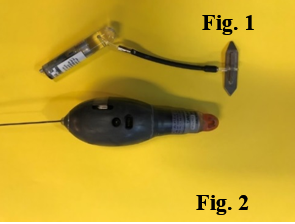
The IPHC will tag 327 Pacific halibut smaller than the commercial minimm size limit (<32 inches [81.3 cm], or “U32”) with electronic archival tags in 2018. These tags, which record temperature, depth, and light levels, will be deployed during this year’s fishery-independent setline survey at a number of locations across the Convention Area. Two types will be deployed, both of which will be attached to the fish’s dark side using a dart-and-tether arrangement. Most will be small (~5 cms [2 in]) and remain on the fish until recaptured (illustrated in Fig. 1); the remainder will be larger “pop-up” tags which release from the tether at a pre-programmed date (Fig. 2). The data will be used to relate temperature to growth and size at age, and to relate light and depth to migrations and seasonal movement. An additional goal is to link otolith (“earbone”) chemistry to temperature so that the IPHC can extend the analyses to untagged fish that are sampled in the commercial catch. It is therefore very important to recover the otoliths from the tagged fish as well as the tag recovery information.

For this reason, rewards for the recovery of these electronic tags will range from $300 to $500, depending on how much information can be provided to the IPHC upon recapture, as follows:

$300: Electronic tag is returned with information regarding the length of the fish and recapture location.

$400: Electronic tag is returned along with the otoliths, fish length, and recapture location.

$500: Whole fish and electronic tag are presented to an IPHC port sampler, allowing the sampler to collect the tag, recovery information, otoliths, and other biological samples.

2018 WIRE TAGGING OF U32 PACIFIC HALIBUT (ONGOING SINCE 2015)

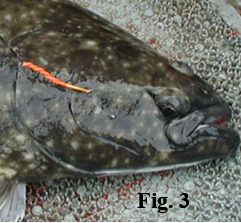
This is the fourth year of wire-tagging U32 Pacific halibut with the goal of gaining insight into movement and growth of younger Pacific halibut. Many of these fish are likely to be caught by trawl gear. The plastic-coated wire tags are various colors, marked with IPHC contact information and tag number, and attached to the dark side cheek area (Fig. 3).

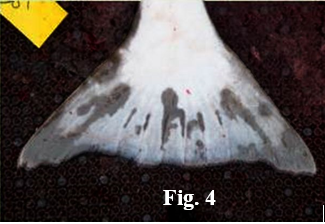
A subset of these fish, tagged with orange tags with the text “PLEASE PHOTOGRAPH TAIL,” are part of a study investigating whether pigmentation patterns on the white side of the tail persist through life and can therefore be used as a natural tag. The IPHC would like fishers and processors encounterning these tags to photograph the tail on the white side (example in Fig. 4) and provide the photo along with the tag and associated recovery information to an IPHC port sampler or the IPHC’s Seattle office.

Fig 1 and 2

INSTRUCTIONS FOR RECOVERED TAGS

Tagged Pacific halibut of any size may be retained from any gear or fishery, whether or not the fisher holds Pacific halibut quota, and at any time of year, although undersized fish may not be sold.

Leave the tag(s) attached to the fish and report the capture at time of landing to an IPHC port sampler, other agency fishery sampler, or contact the IPHC Seattle office at (206) 634-1838. IPHC has samplers in Dutch Harbor, Kodiak, Homer, Seward, Sitka, Juneau, and Petersburg, AK, as well as Prince Rupert and Port Hardy, BC, throughout the commercial halibut season, and in St. Paul, AK, during July and August.

If you catch a tagged Pacific halibut, and are landing in a port not staffed by an IPHC employee or other agency fish sampler, please return the tag with the following information: recovery date and location, fish length, sex, otoliths, and finder’s name and address to the IPHC’s Seattle office at the following address:

2320 West Commodore Way, Suite 300, Seattle, WA 98199, USA

2018 TAG REWARDS

A reward is paid for all IPHC tags. The reward amount depends on the tag type and, in some cases, the reward is also dependent on the data returned with the tag. The standard reward for an IPHC tag is a baseball cap, knit cap, or $10. Electronic tags have higher-value reward amounts, ranging between $100 and $500, and have the reward amount printed on the tag. The metal dart and leader assembly from pop-up tags is rewarded at $50. Wire tags bearing the text “PLEASE PHOTOGRAPH TAIL” will be redeemed at $20 or two hats if both the tag and a photo of the white side tail are returned; if only the tag is returned, the standard reward applies.

More information on Pacific halibut tagging studies can be found on the IPHC website: https://www.iphc.int/management/science-and-research/biological-and-ecosystem-science-research-program-bandesrp/bandesrp-migration/tagging. Tag-related questions can also be directed to secretariat@iphc.int.

ONGOING SUBSCRIPTION TO IPHC NEWS RELEASES

Dear Reader: The IPHC is moving towards fully electronic information distribution. As such, if you would like to continue to receive IPHC news in the future, please click the following link to subscribe: https://www.iphc.int/form/news-letter. Hard copies of news releases and similar bulletins will cease in the coming months.

David T. Wilson, Ph.D.
Executive Director, IPHC
Phone: (206) 634-1838
Fax:     (206) 632-2983
Web:  iphc.int

Document

Title

PDF

Report #

Year

Date Published

IPHC-2018-NR014

IPHC Pacific halibut tagging studies

18 June 2018

IPHC News Release 2018-016 Recreational Fisheries: Columbia River Subarea Nearshore Closure

29 June 2018

IPHC NEWS RELEASE 2018-016

RECREATIONAL FISHERIES: COLUMBIA RIVER SUBAREA NEARSHORE CLOSURE

Closed: Columbia River subarea nearshore Pacific halibut recreational fisheries. The catch estimates from the Columbia River subarea nearshore subarea indicate that the 500 lb (~0. 227 t) allocation has been attained. As a result, the Columbia River subarea nearshore Pacific halibut recreational fisheries will close at the end of the day Saturday, 30 June 2018 and will remain closed for the remainder of 2018.

For more information on these fishery updates please refer to:

Oregon: Department of Fish and Wildlife website:

http://www.dfw.state.or.us/MRP/finfish/halibut/index.asp

For further recreational fishery retention information, call the NMFS hotline (1-800-662-9825 press 7 for Pacific halibut information).

Due to the short notice nature of this notification, it is posted to our website only, and no paper copy has been mailed out.

ONGOING SUBSCRIPTION TO IPHC NEWS RELEASES

Dear Reader: The IPHC is moving towards fully electronic information distribution. As such, if you would like to continue to receive IPHC news in the future, please click the following link to subscribe: https://www.iphc.int/form/news-letter. Hard copies of news releases and similar bulletins will cease in the coming months.  

– END –

David T. Wilson, Ph.D.
Executive Director, IPHC
Phone: (206) 634-1838
Fax:     (206) 632-2983
Web:  www.iphc.int

Document

Title

PDF

Report #

Year

Date Published

IPHC-2018-NR016

Recreational Fisheries: Columbia River Subarea Nearshore Closure

29 June 2018

IPHC News Release 2018-017 Non-Treaty Directed Commercial Fishery: Fishing Period Limits in IPHC Regulatory Area 2A For 11 July 2018 Fishing Period

3 July 2018

IPHC NEWS RELEASE 2018-017

NON-TREATY DIRECTED COMMERCIAL FISHERY:

FISHING PERIOD LIMITS IN IPHC REGULATORY AREA 2A

FOR 11 JULY 2018 FISHING PERIOD

The International Pacific Halibut Commission (IPHC) has determined the following catch limits shall apply for the 11 July 2018, 10-hour non-treaty directed commercial fishery (the fishery) in IPHC Regulatory Area 2A. The overall catch limit for this fishery is 201,845 pounds; 91.56 metric tons.

The 11 July 2018 fishing period will begin at 08:00 hrs and end at 18:00 hrs Pacific Daylight Time. The fishery is restricted to waters south of Point Chehalis, Washington (46°53.30’ N. latitude) under regulations promulgated by the National Oceanic and Atmospheric Administration (NOAA) Fisheries. Fishing period limits as indicated in the following table will be in effect for this opening.

Vessel ClassFishing period catch limit
LengthLetterDressed, head-on with ice/slime (pounds)Dressed, head-on with ice/slime (metric tons)
0-25A8600.39
26-30B1,0750.49
31-35C1,7150.78
36-40D4,7352.15
41-45E5,0902.31
46-50F6,0952.76
51-55G6,8003.08
56+H10,2254.64

The appropriate vessel length class and letter are printed on each vessel license. The fishing period catch limit applies to the vessel, not the individual fisher, and any landings over the vessel limit will be subject to forfeiture and fine.

The fishing period catch limit is shown in terms of dressed, head-on weight, and fishers are reminded that regulations require that all Pacific halibut be landed with the head naturally attached. Additionally, fishers are reminded that there is a 72-hour rule, whereby a vessel that will be used in the fishery may not be used to fish for any species of fish anywhere in IPHC Regulatory Area 2A during the 72-hour period immediately before the non-Treaty directed commercial fishery fishing period unless all catch of other species has been completely offloaded or the vessel submits to a hold inspection by an authorized officer prior to the start of the fishing period (see IPHC Pacific Halibut Fishery Regulations 2018, sections 20(7)(a)(b) and 20(8)(a)(b)).

…continued

NOAA Fisheries has implemented mandatory area closures that are in effect for the directed Pacific halibut fishery to protect specific rockfish species. For the exact coordinates of the closed areas, go to the following web page:

http://www.westcoast.fisheries.noaa.gov/fisheries/management/groundfish_closures/groundfish_closed_areas.html. For further information, call the NOAA Fisheries hotline at 1‑800-662-9825, then press “7” for the Pacific halibut fisheries.

Due to the short notice nature of this notification, it is posted to our website only, and no paper copy has been mailed out.

ONGOING SUBSCRIPTION TO IPHC NEWS RELEASES

Dear Reader: The IPHC is moving towards fully electronic information distribution. As such, if you would like to continue to receive IPHC news in the future, please click the following link to subscribe: https://www.iphc.int/form/news-letter. Hard copies of news releases and similar bulletins will cease in the coming months.  

– END –

David T. Wilson, Ph.D.
Executive Director, IPHC
Phone: (206) 634-1838
Fax:     (206) 632-2983
Web:  www.iphc.int

Document

Title

PDF

Report #

Year

Date Published

IPHC-2018-NR017

Non-Treaty Directed Commercial Fishery: Fishing Period Limits in IPHC Regulatory Area 2A For 11 July 2018 Fishing Period

3 Jul 2018

IPHC News Release 2018-018 Non-Treaty Directed Commercial Fishery: Fishing Period Limits in IPHC Regulatory Area 2A For 25 July 2018 Fishing Period

18 July 2018

The International Pacific Halibut Commission (IPHC) has determined the following catch limits shall apply for a 25 July 2018, 10-hour non-treaty directed commercial fishery opening (the fishery) in IPHC Regulatory Area 2A. The overall catch limit for this fishery is 201,845 pounds; 91.56 metric tons.

The 25 July 2018 fishing period will begin at 08:00 hrs and end at 18:00 hrs Pacific Daylight Time. The fishery is restricted to waters south of Point Chehalis, Washington (46°53.30’ N. latitude) under regulations promulgated by the National Oceanic and Atmospheric Administration (NOAA) Fisheries. Fishing period limits as indicated in the following table will be in effect for this opening.

Vessel ClassFishing period catch limit
LengthLetterDressed, head-on with ice/slime (pounds)Dressed, head-on with ice/slime (metric tons)
0-25A3800.17
26-30B4750.22
31-35C7600.34
36-40D2,1000.95
41-45E2,2601.03
46-50F2,7101.23
51-55G3,0251.37
56+H4,5452.06

The appropriate vessel length class and letter are printed on each vessel license. The fishing period catch limit applies to the vessel, not the individual fisher, and any landings over the vessel limit will be subject to forfeiture and fine.

The fishing period catch limit is shown in terms of dressed, head-on weight, and fishers are reminded that regulations require that all Pacific halibut be landed with the head naturally attached. Additionally, fishers are reminded that there is a 72-hour rule, whereby a vessel that will be used in the fishery may not be used to fish for any species of fish anywhere in IPHC Regulatory Area 2A during the 72-hour period immediately before the non-Treaty directed commercial fishery fishing period unless all catch of other species has been completely offloaded or the vessel submits to a hold inspection by an authorized officer prior to the start of the fishing period (see IPHC Pacific Halibut Fishery Regulations 2018, sections 20(7)(a)(b) and 20(8)(a)(b)).

NOAA Fisheries has implemented mandatory area closures that are in effect for the directed Pacific halibut fishery to protect specific rockfish species. For the exact coordinates of the closed areas, go to the following web page: http://www.westcoast.fisheries.noaa.gov/fisheries/management/groundfish_closures/groundfish_closed_areas.html. For further information, call the NOAA Fisheries hotline at 1 800-662-9825, then press “7” for Pacific halibut fisheries.

Due to the short notice nature of this notification, it is posted to our website only, and no paper copy has been mailed out.

ONGOING SUBSCRIPTION TO IPHC NEWS RELEASES

Dear Reader: The IPHC is moving towards fully electronic information distribution. As such, if you would like to continue to receive IPHC news in the future, please click the following link to subscribe: https://www.iphc.int/form/news-letter. Hard copies of news releases and similar bulletins will cease in the coming months.

– END –

David T. Wilson, Ph.D.
Executive Director, IPHC
Phone: (206) 634-1838
Fax:     (206) 632-2983
Web:  www.iphc.int

Document

Title

PDF

Report #

Year

Date Published

IPHC-2018-NR018

Non-Treaty Directed Commercial Fishery: Fishing Period Limits in IPHC Regulatory Area 2A For 25 July 2018 Fishing Period

18 Jul 2018

IPHC News Release 2018-019 2018 Pacific Halibut Landing Report No. 3

2 August 2018

IPHC NEWS RELEASE 2018-019

IPHC REGULATORY AREA 2A NON-TREATY DIRECTED COMMERCIAL PACIFIC HALIBUT FISHERY: CLOSED

The International Pacific Halibut Commission reports that the total catch limit for the IPHC Regulatory Area 2A non-treaty directed commercial Pacific halibut fishery has been reached following the 25 July 2018 fishing period. Therefore, the IPHC Regulatory Area 2A non-treaty directed commercial Pacific halibut fishery is closed for the remainder of 2018.

2018 PACIFIC HALIBUT LANDING REPORT NO. 3

IPHC Regulatory AreaFishery limits (net weight)Landings (net weight)
Pounds (lb)Tonnes (t)Pounds (lb)Tonnes (t)
Area 2A (California, Oregon, and Washington)1,190,000539,78
  Non-treaty directed commercial (south of Pt. Chehalis201,84591.56217,82598.80
  Non-treaty incidental catch in salmon troll fishery35,62016.1630,45613.81
  Non-treaty incidental catch in sablefish fishery (north of Pt. Chehalis)50,00022.6813,6756.20
  Treaty Indian commercial389,500176.68408,703185.38
  Treaty Indian ceremonial and subsistence (year-round)27,00012.25no datano data
  Recreational – Washington225,366102.22222,260100.82
  Recreational – Oregon229,730104.20141,81964.33
  Recreational – California30,94014.0313,8366.28
Area 2B (British Columbia)6,223,9852,823.18
  Commercial fishery5,295,9952,402.253,413,8611,548.50
  Recreational fishery927,990420.93no datano data
Area 2C (southeastern Alaska)4,450,0002,018.51
  Commercial fishery (IFQ)3,570,0001,619.322,287,0691,037.40
  Guided recreational fishery810,000367.41no datano data
Area 3A (central Gulf of Alaska)9,450,0004,286.49
  Commercial fishery7,350,0003,333.914,694,0572,129.19
  Guided recreational fishery1,790,000811.94no datano data
Area 3B (western Gulf of Alaska)2,620,0001,188.411,052,189477.26
Area 4A (eastern Aleutians)1,370,000621.42440,679199.89
Area 4B (central/western Aleutians)1,050,000476.24588,300266.85
Areas 4CDE1,580,000716,68 482,3931 218.811
  Area 4C (Pribilof Islands)733,500332.7111
  Area 4D (northwestern Bering Sea)733,500332.71 1 1
  Area 4E (Bering Sea flats)113,00051.2611
Total227,553,98612,498.2814,007,1226,353.53
1Total landings in IPHC Regulatory Area 4CDE are combined to meet confidentiality requirements.
2Totals do not include Regulatory Area 2C and 3A discard mortality.

QUOTA SHARE COMMERCIAL FISHERIES UPDATE

The 2018 quota share Pacific halibut fisheries opened on 24 March 2018. It is estimated that the following commercial landings, by weight and number of landings, occurred in the Alaskan Individual Fishing Quota (IFQ) and Community Development Quota (CDQ) fisheries and in the British Columbian Individual Vessel Quota (IVQ) fishery through 30 July 2018.

IPHC Regulatory AreaCatch LimitLandingsProportionNumber of Landings
‘000s lbTonnes‘000s lbTonnes
2C3,5701,6192,2871,03764.06688
3A7,3503,3344,6942,12963.86879
3B2,6201,188  1,05247740.15137
4A1,37062144120032.1959
4B1,05047658826756.0055
4CDE1,58071748221930.51352
USA total17,5407,9559,5454,32954.422,170
2B (Canada) total5,2962,4023,4141,54964.46347
Grand Total22,83610,35812,9595,87856.752,517

Totals may differ from area sums due to rounding

Canada: The landings from IPHC Regulatory Area 2B (British Columbia) waters represent ~64% of the 2018 commercial fishery catch limit. For comparison, 3.5 Mlb, 1,588 t, or ~57% of the 2017 catch limit, had been landed from IPHC Regulatory Area 2B by this same date in 2017. Also, during the first 128 days of the 2017 IVQ fishery, 3.2 Mlb, 1,451 t, or 51% of the catch limit, had been landed.

United States of America: The landings from IPHC Regulatory Areas 2C, 3, and 4 (Alaska) represent ~54% of the 2018 quota share commercial fishery catch limit. For comparison, 11.0 Mlb, 4,990 t, or ~57% of the 2017 catch limit, were landed in the Alaskan fishery by this same date in 2017; however, the opening date of the 2017 fishery occurred 13 days earlier in the year than that of the 2018 fishery. For comparison, using a similar fishing period length, during the first 128 days of the 2017 Alaska commercial Pacific halibut fishery, 10.1 Mlb, 4,581 t, or 52% of the catch limit, were landed.

IPHC REGULATORY AREA 2A COMMERCIAL TREATY INDIAN FISHERIES

In 2018, the Pacific Fishery Management Council (PFMC) allocated 389,500 lbs, 177 t of Pacific halibut for commercial use to the Treaty Indian tribes of IPHC Regulatory Area 2A. A total of 408,703 lbs, 185 t, of Pacific halibut have been reported landed.

IPHC REGULATORY AREA 2A INCIDENTAL COMMERCIAL PACIFIC HALIBUT FISHERY DURING THE SALMON TROLL SEASON

The total allowable incidental commercial catch of Pacific halibut allocated to the IPHC Regulatory Area 2A salmon troll fishery is 35,620 lbs, 16.16 t. Incidental catch of Pacific halibut in the salmon troll fishery was allowed beginning 01 April 2018. It is estimated 30,456 lbs, 13.81 t of Pacific halibut have been landed through 24 July 2018. Landing limits effective 26 July 2018 are as follows: one Pacific halibut per each three Chinook, except one Pacific halibut may be possessed or landed without meeting the ratio requirement, and no more than 10 Pacific halibut may be possessed or landed per trip. For details on incidental fishery retention information, call the NMFS hotline (1 800-662-9825 press 7 for Pacific halibut information).

IPHC REGULATORY AREA 2A INCIDENTAL COMMERCIAL PACIFIC HALIBUT FISHERY DURING THE LIMITED ENTRY, FIXED-GEAR SABLEFISH FISHERY

The total allowable incidental commercial catch of Pacific halibut allocated to the limited entry, fixed-gear sablefish fishery, which operates in IPHC Regulatory Area 2A north of Point Chehalis, Washington, is 50,000 lbs, 22.7 t. Incidental catch of Pacific halibut in the sablefish fishery was permitted beginning 01 April 2018. Preliminary landing estimates indicate that 13,675 lbs, 6.2 t of Pacific halibut have been landed through 05 June 2018. For further incidental fishery retention information, call the NMFS hotline (1-800-662-9825 press 7 for Pacific halibut information).

ANNETTE ISLANDS RESERVE FISHERY IN IPHC REGULATORY AREA 2C

The Metlakatla Indian Community has been authorized by the Government of the United States of America to conduct a commercial Pacific halibut fishery within the Annette Islands Reserve. The following table lists Pacific halibut catch and numbers of participating vessels by fishing period.

Fishing Period DatesPoundsTonnesNumber of Vessels
23 – 25 March1,8770.855
06 – 08 April7480.344
20 – 22 April1,6450.756
04 – 06 May2,5521.168
25 – 27 May1,0870.496
08 – 10 June1,5190.695
22 – 24 June1,5880.725
06 – 08 July1,5350.704
20 – 22 July1,9990.914

The total landed weight of Pacific halibut reported to date is 14,550 lbs, 6.6 t. The Metlakatla Indian Community and the Bureau of Indian Affairs will announce future Pacific halibut openings.

ONGOING SUBSCRIPTION TO IPHC NEWS RELEASES

Dear Reader: The IPHC is moving towards fully electronic information distribution. As such, if you would like to continue to receive IPHC news in the future, please click the following link to subscribe: https://www.iphc.int/form/news-letter. Hard copies of news releases and similar bulletins will cease in the coming months.

– END –

David T. Wilson, Ph.D.
Executive Director, IPHC
Phone: (206) 634-1838
Fax:     (206) 632-2983
Web:  www.iphc.int

Document

Title

PDF

Report #

Year

Date Published

IPHC-2018-NR019

2018 Pacific Halibut Landing Report No. 3

2 August 2018

IPHC News Release 2018-020 IPHC Regulatory Area 2A Pacific Halibut Fishery Incidental To The Salmon Troll Fishery: Closed

10 August 2018           

IPHC NEWS RELEASE 2018-20

IPHC REGULATORY AREA 2A PACIFIC HALIBUT FISHERY INCIDENTAL TO THE SALMON TROLL FISHERY: CLOSED

The International Pacific Halibut Commission reports that the total catch limit for the IPHC Regulatory Area 2A Pacific halibut fishery incidental to the salmon troll fishery has been reached.  Therefore, the IPHC Regulatory Area 2A Pacific halibut fishery incidental to the salmon troll fishery is closed for the remainder of 2018.

For more information on retention and landing restrictions, please visit the Oregon Department of Fish and Wildlife website at http://www.dfw.state.or.us/mrp/salmon/updatesnew.asp (8/8/18, Action Notice 2 of 2).

Due to the short notice nature of this notification, it is posted to our website only, and no paper copy has been mailed out.

ONGOING SUBSCRIPTION TO IPHC NEWS RELEASES

Dear Reader: The IPHC is moving towards fully electronic information distribution. As such, if you would like to continue to receive IPHC news in the future, please click the following link to subscribe: https://www.iphc.int/form/news-letter. Hard copies of news releases and similar bulletins will cease in the coming months.  

– END –

David T. Wilson, Ph.D.
Executive Director, IPHC
Phone: (206) 634-1838
Fax:     (206) 632-2983
Web:  www.iphc.int

Document

Title

PDF

Report #

Year

Date Published

IPHC-2018-NR020

IPHC Regulatory Area 2A Pacific Halibut Fishery Incidental To The Salmon Troll Fishery: Closed

10 August 2018

IPHC News Release 2018-021 IPHC Regulatory Proposals for the 2018-19 Process

5 September 2018                   

IPHC NEWS RELEASE 2018-21

IPHC REGULATORY PROPOSALS FOR THE 2018-19 PROCESS

The International Pacific Halibut Commission (IPHC) announces the following dates and information for use when developing and submitting proposals for new, or amending existing, IPHC Pacific Halibut Fishery Regulations for the 2018/19 process.

For the IPHC INTERIM MEETING: the 94th Session of the IPHC Interim Meeting (IM094) takes place 27-28 November 2018. The Regulatory Proposal deadline for IM094 is 28 October 2018.

For the IPHC ANNUAL MEETING: the 95th Session of the IPHC Interim Meeting (AM095) takes place 28 January – 01 February 2019. The Regulatory Proposal deadline for AM095 is 29 December 2018.

Although it is not mandatory to submit draft Regulatory Proposals to the IPHC Interim Meeting, it is highly encouraged as it will provide the Commissioners and IPHC Secretariat additional time to seek clarification if necessary.

In addition, we are pleased to announce the launching of the IPHC Fishery Regulations portal, now available for use on the IPHC website. All proposals for new or revised Fishery Regulations must be submitted electronically through this portal:

Fishery Regulations: https://www.iphc.int/the-commission/fishery-regulations/

Regulatory Proposal submission form: https://www.iphc.int/form/regulatory-proposal

ONGOING SUBSCRIPTION TO IPHC NEWS RELEASES

Dear Reader: The IPHC is moving towards fully electronic information distribution. As such, if you would like to continue to receive IPHC news in the future, please click the following link to subscribe: https://www.iphc.int/form/news-letter. Hard copies of news releases and similar bulletins will cease in the coming months.  

– END –

David T. Wilson, Ph.D.
Executive Director, IPHC
Phone: (206) 634-1838
Fax:     (206) 632-2983
Web:  www.iphc.int

Document

Title

PDF

Report #

Year

Date Published

IPHC-2018-NR021

IPHC Regulatory Proposals for the 2018-19 Process

5 Sept 2018