SEATTLE – The International Pacific Halibut Commission (IPHC) will be conducting its annual fishery-independent setline survey (FISS) this year. The FISS will be conducted off the coast of Oregon, Washington, British Columbia, and Alaska during the 2022 fishing period. IPHC will be selling Pacific halibut caught and sampled during these operations to offset the costs associated with conducting the research, in accordance with The Convention between Canada and the United States of America for the preservation of the [Pacific] halibut fishery of the Northern Pacific ocean and Bering sea (Article III, paragraph 2).
This media release is intended to notify processors of the IPHC’s plan to sell fish and to update lists of interested buyers in ports where IPHC-chartered vessels will offload catch.
A total of 10-13 vessels will be involved in the IPHC FISS, with landings between early June and early September. Average trip poundage for Pacific halibut ranges from 5,000 to 35,000 pounds, plus lesser amounts of rockfish (Sebastes spp.) and Pacific cod. Please note that IPHC will also be selling U32 Pacific halibut that have been sampled during the FISS. The condition of fish prior to each landing will be communicated in the individual sales announcement. As an update to our fish sales protocols for 2022, all applicable tax deductions must be listed on the bid with exact rates shown.
Sales will be awarded based on the IPHC’s objectives of achieving a fair market price. Sales agreements will be based on prices at the time of the sale. The IPHC will not enter into any consignment or profit-sharing arrangements. The IPHC plans to contact interested Pacific halibut buyers prior to each landing. Preferences will be given to buyers with a history of successfully marketing Pacific halibut and following ethical business practices. In awarding sales, the IPHC will consider: (1) price; (2) the number of years buyers have been buying and marketing Pacific halibut; (3) how fish are graded, including the determination of No. 2 Pacific halibut and chalky fish; and (4) promptness in settlements following deliveries. Obtaining a fair market price will be a primary consideration in awarding fish sales. The IPHC will also attempt to distribute sales among as many qualified buyers as possible, subject to fair market value.
All buyers (including those with past IPHC sales history) interested in purchasing IPHC FISS fish in 2022 should complete the Interested Buyer Form.
Replying to this news release will ensure you are kept informed of purchasing opportunities throughout our field season. For further information, please contact IPHC Secretariat at (206) 634-1838 or via email at Secretariat@iphc.int.
IPHC Secretariat International Pacific Halibut Commission 2320 W. Commodore Way, Suite 300 Seattle, WA 98199-1287 206-634-1838 | www.iphc.int
SEATTLE – The International Pacific Halibut Commission (IPHC) funds several Merit Scholarships to support university, technical college, and other post-secondary education. The scholarship fund has been established to assist the further education of Canadian and U.S.A. students connected to the Pacific halibut fishery and its industry. Generally, a single new scholarship valued at US $4000 per year is awarded every two years. The scholarships are renewable annually for the normal four-year period of undergraduate education, subject to maintenance of satisfactory academic performance. A committee of industry and Commission representatives reviews applications and determines recipients based on academic qualifications, career goals, and relationship to the Pacific halibut industry.
The scholarship for 2022 will be available for educational entrance or continuation in Fall of 2022. Applications must be submitted via the electronic form posted under the IPHC Merit Scholarships tab on the the Commission’s website Opportunities page linked here:
SEATTLE – The International Pacific Halibut Commission (IPHC) is seeking to charter longline vessels to conduct its Fishery-Independent Setline Survey (FISS) in 2022 in the following FISS Charter Regions only:
Gore Point (35 stations)
Portlock (40 stations)
Shelikof (45 stations)
Semidi (27 stations)
Chignik (35 stations)
Shumagin (26 stations)
Sanak (49 stations)
4CDE North (40 stations)
Attu (61 stations west of Kiska)
The primary purpose of the FISS is to collect standardised data for use in the Pacific halibut stock assessment. This information is also used to study aspects of the Pacific halibut resource such as growth, distribution, biomass, age composition, sexual maturity, and relative abundance of other species. Legal-sized Pacific halibut and Pacific halibut less than 32 inches in length that have been sampled, as well as incidentally caught fish (byproduct) that will die upon release will be retained, sampled for biological data and sold by the IPHC to offset FISS expenses.
The 2022 FISS will cover 28 charter regions within the IPHC Convention Area with a standard grid of stations from Oregon to the northern Bering Sea, including the Aleutian Islands. The FISS must be completed between 27 May and 31 August 2022.
The IPHC will consider only those vessels with captains and crews that have recent (within five years) Pacific halibut fishing experience. The IPHC may require an inspection of the vessel prior to awarding the charter.
Vessels need not be licensed for Pacific halibut fishing in Canada or the USA to be eligible. The IPHC is not restricted as to nationality of the vessels it charters for operation in any region as long as customs and immigration regulations are followed.
Interested vessel owners are invited to submit tenders based upon the 2022 IPHC Fishery-Independent Setline Survey (FISS) Vessel Tender Specifications. The Tender Specifications and Vessel Tender Forms for this project may be downloaded and accessed directly from the IPHC website: Vessel Recruiting | IPHC.
The IPHC will not be obligated to accept the tender with the lowest bid or any tender received and will contract according to its best interests.
Vessels will be rated using the following criteria:
1) seaworthiness and general condition of the vessel and its equipment,
2) the vessel’s availability within the schedule determined solely by the IPHC Secretariat,
3) the vessel captain’s experience and fishing record,
4) the qualifications of the selected crew,
5) IPHC operating costs (tender amounts)
6) Previous interactions with the IPHC and its Secretariat, experience with the IPHC FISS, scheduling flexibility, and ability to take additional Secretariat are other factors to be potentially considered in the decision-making process.
***Preference may also be given to tenders that provide proof of COVID-19 vaccination***
All IPHC Secretariat personnel are required to be vaccinated – proof is available to vessel captains upon request.
For further information please contact the IPHC Secretariat at secretariat@iphc.int or 206.634.1838.
IPHC Secretariat International Pacific Halibut Commission 2320 W. Commodore Way, Suite 300 Seattle, WA 98199-1287 206-634-1838 | www.iphc.int
SEATTLE – The International Pacific Halibut Commission (IPHC) completed the 98th Session of the IPHC Annual Meeting (AM098) on 28 January 2022 with decisions on total mortality limits, fishing period dates, and other fishery regulation changes. A total of 172 individuals attended the meeting via the electronic platform, in addition to the delegations from Canada (12) and the United States of America (15).
IPHC Media Release 2022-002 reported the initial results of AM098. Selected additional decisions of the 98th Session of the IPHC Annual Meeting (AM098) are highlighted below.
PACIFIC HALIBUT STOCK STATUS AND OUTLOOK
The Commission NOTED the following scientific advice from the IPHC Secretariat:
“Sources of mortality: In 2021, total Pacific mortality due to fishing increased to 37.66 million pounds (17,084 t) but remained below the 5-year average of 38.48 million pounds (17,456 t). Of that total, 88% comprised the retained catch, up from 84% in 2020.”
“Fishing intensity: The 2021 fishing mortality corresponded to a point estimate of SPR = 46%; there is a 47% chance that fishing intensity exceeded the IPHC’s current reference level of F43%. The Commission does not currently have a coastwide fishing intensity limit reference point.”
“Stock status (spawning biomass): Current (beginning of 2022) female spawning biomass is estimated to be 191 million pounds (86,600 t), which corresponds to a 45% chance of being below the IPHC trigger reference point of SB30%, and less than a 1% chance of being below the IPHC limit reference point of SB20%. The stock is estimated to have declined by 17% since 2016 but is currently at 33% of the unfished state. Therefore, the stock is considered to be ‘not overfished’. Projections indicate that mortality consistent with the interim management procedure reference fishing intensity (F43%) is likely to result in further declining biomass levels in the near future.”
“Stock distribution: The proportion of the coastwide stock represented by Biological Region 3 has increased sharply over 2020-21, reversing over a decade of steady decline. This trend occurs in tandem with declines in Biological Regions 2 and 4; however, all regions remain within the historical range observed from 1993-2021. These estimates have been updated and strongly informed by the comprehensive FISS design implemented in 2021.”
The Commission NOTED the following outlook for the stock provided by the IPHC Secretariat:
“Outlook. The projections for this assessment are more optimistic than those from the 2019 and 2020 assessments due to the increasing projected maturity of the 2012 year-class. This translates to a lower probability of stock decline for 2022 than in recent assessments as well as a decrease in this probability through 2023-24. There is greater than a 50% probability of stock decline in 2023 (55-64/100) for the entire range of SPR values from 40-46%, which include the status quo TCEY and the F43% reference level. The 2022 “3-year surplus” alternative, corresponds to a TCEY of 38.0 million pounds (~17,240 t), and a projected SPR of 48% (credible interval 32-63%). At the reference level (a projected SPR of 43%), the probability of spawning biomass decline from 2022 to 2023 is 59%, decreasing to 55% in three years, as the 2012 cohort matures. The one-year risk of the stock dropping below SB30% ranges from 43% at the F46% level to 45% at the at the F40% level of fishing intensity.”
IPHC PACIFIC HALIBUT FISHERY REGULATIONS 2022
The Commission approved a series of IPHC fishery regulation changes for 2022, including mortality limits and fishing periods. In accordance with the IPHC Convention1, the fishery regulations approved by the IPHC have been recommended to the Contracting Parties for implementation according to their domestic laws.
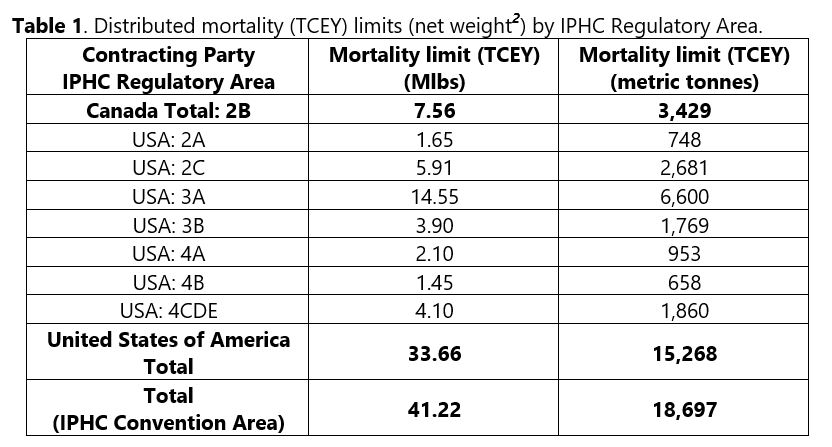
The Commission ADOPTED the distributed mortality limits for each Contracting Party, by IPHC Regulatory Area and sector, as provided in Table 1.
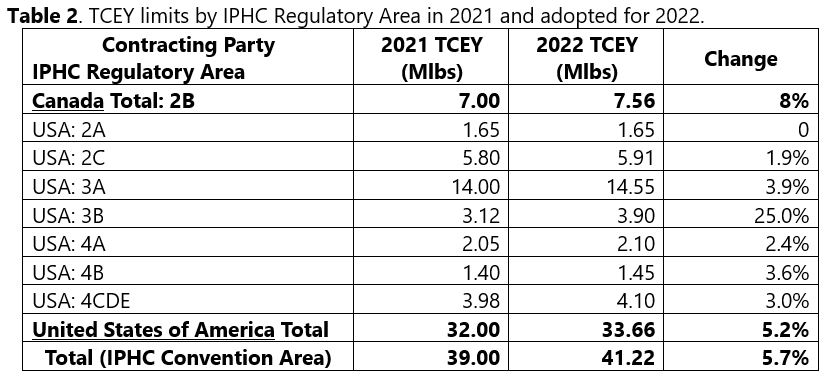
The adopted mortality limits imply 6% increase with respect to 2021, as presented in Table 2.
Commercial fishing periods (Sect. 9)
The Commission ADOPTED fishing periods for 2021 as provided below, thereby superseding the relevant portions of Section 9 of the IPHC Pacific halibut fishery regulations by specifying that commercial fishing for Pacific halibut in all IPHC Regulatory Areas may begin no earlier than 6 March and must cease on 7 December.
This implies same fishing periods as in 2021.
Charter management measures in IPHC Regulatory Areas 2C and 3A (Sect. 29)
The Commission ADOPTED charter management measures for IPHC Regulatory Areas 2C and 3A for 2022:
IPHC Regulatory Area 2C – one-fish bag limit with size limit of less than or equal to 40 inches or greater than or equal to 80 inches
IPHC Regulatory Area 3A – two-fish bag limit with one fish of any size and a second fish less than or equal to 28 inches, Wednesdays and two Tuesdays (7/26 and 8/2) closed to retention of Pacific halibut, one trip per vessel, one trip per CHP per day, and no annual limit
Recordkeeping requirements for annual limits (not applicable in 2022)
Trap gear use in IPHC Regulatory Area 2B (Sect. 18)
The Commission ADOPTED proposed IPHC Regulation changes to allow trap gear use on directed commercial trips in IPHC Regulatory Area 2B. The Commission also expressed interest in sharing experience between Contracting Parties on the effectiveness of the use of traps/pots in preventing whale depredation.
Fishery-Independent Setline Survey (FISS)
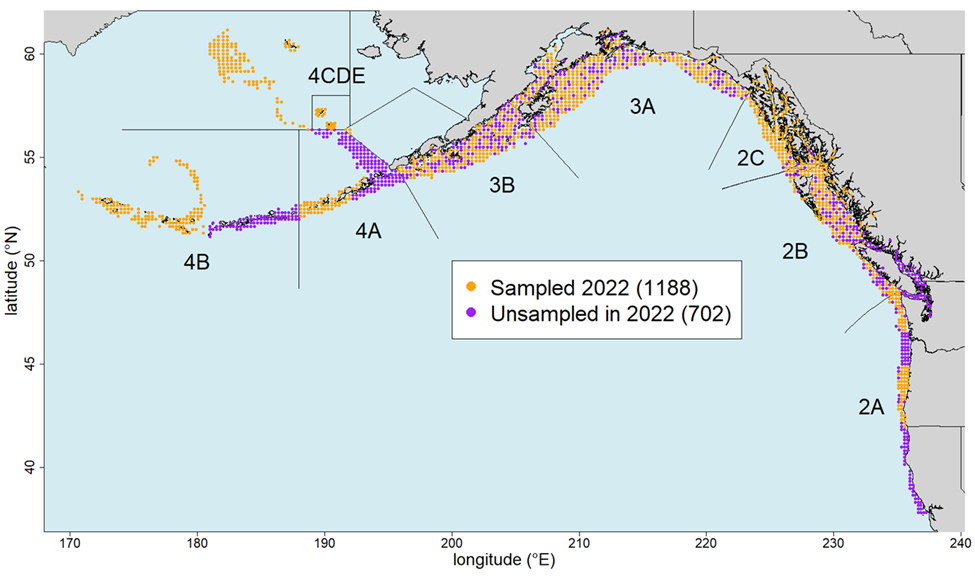
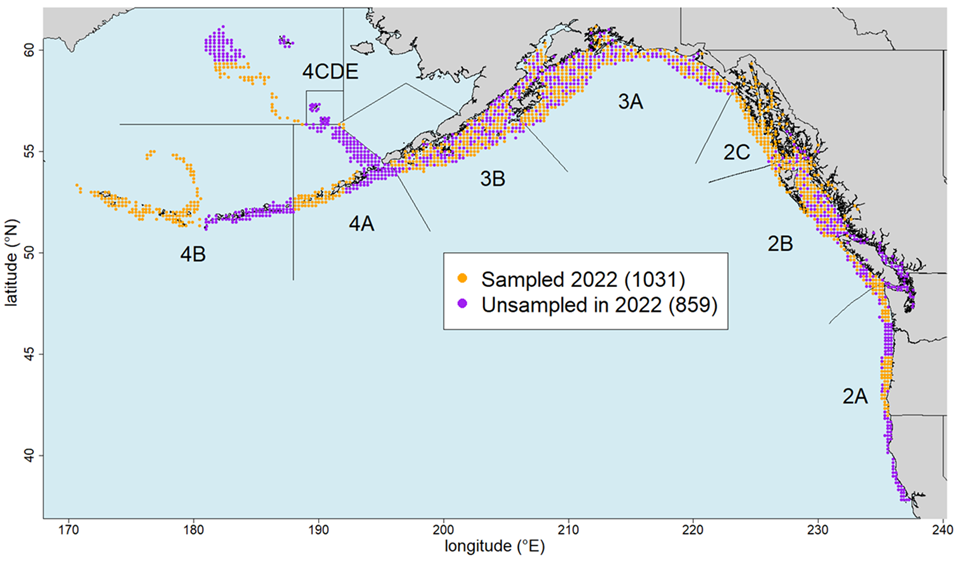
The Commission RECALLED the IM097 endorsement of the FISS design options for 2022 (Figures 1 and 2) and provisional endorsement of the designs for 2023 and 2024, and made no further amendments at AM098.
Figure 1. Endorsed optimized FISS design for 2022.
Figure 2. Alternative endorsed optimized FISS design for 2022.
Upcoming IPHC meetings
The Commission accepted the offer by Canada to host the 99th Session of the IPHC Annual Meeting (AM099) in 2023 in Victoria, BC, Canada from 23 to 27 January 2023.
Should the COVID-19 pandemic remain an issue at that time, the meeting may be held electronically.
The Commission will also hold electronically on 25th of February a Special Session (SS012) that will include the following agenda items: 1) FY2023 budget review and adoption; 2) Management Strategy Evaluation; 3) IPHC Fishery Regulations: Daily bag limit in IPHC Regulatory Area 2B (Sect. 28).
The Commission noted that it will be celebrating in 2024 its 100th Anniversary. Over the coming year, the Contracting Parties will collaborate to agree on any additional activities to be associated with the anniversary.
Officers of the Commission
The Commission elected Mr Paul Ryall (Canada) as Chairperson of the IPHC, and Mr Glenn Merrill (USA) as Vice-Chairperson of the IPHC.
IPHC Secretariat International Pacific Halibut Commission 2320 W. Commodore Way, Suite 300 Seattle, WA 98199-1287 206-634-1838 | www.iphc.int
1The Convention between Canada and the United States of America for the Preservation of the [Pacific] Halibut Fishery of the Northern Pacific Ocean and Bering Sea.
2 “net weight” of a Pacific halibut means the weight of Pacific halibut that is without gills and entrails, head-off, washed (without ice and slime). If a Pacific halibut is weighed with the head on or with ice and slime, the required conversion factors for calculating net weight are a 2 percent deduction for ice and slime and a 10 percent deduction for the head.