Pacific halibut are captured from the depths of the north Pacific Ocean and Bering Sea in a number of ways. The fish are primarily targeted by the commercial longline fishery and by recreational fishers, as well as taken for personal use (subsistence). Additional mortality occurs in the form of non-directed commercial discard mortality (bycatch) in commercial fisheries targeting other species that are not allowed to retain Pacific halibut. Over the last half century, Pacific halibut removals from all sources have ranged annually from 13,063 to 45,323 metric tons (28.8 to 99.9 million pounds), with an average of 29,793 mt (65.7 million pounds). Total removals in 2025 were 13,063 mt (28.8 million pounds), a 12% decrease from 2024 (14,842 mt or 32.7 million pounds), and 57% below the 50-year average. In 2025, an estimated 7,575 mt (16.7 million pounds) were landed from commercial fisheries (including landings from the
Fishery-Independent Setline Survey or FISS), 2,595 mt (5.7 million pounds) from recreational fisheries, 2,522 mt (5.6 million pounds) from directed and non-directed commercial discard mortality, and 372 mt (0.8 million pounds) from subsistence.
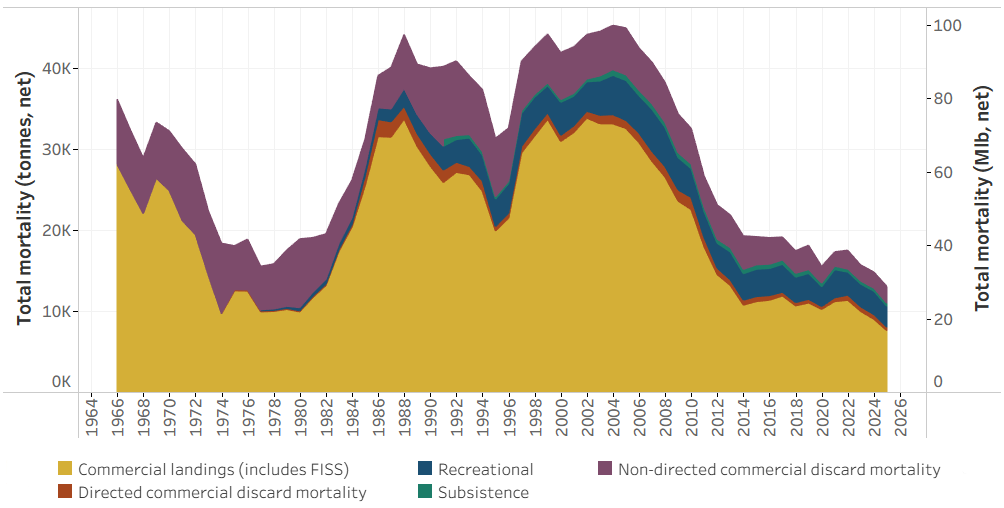
Data depicted in the figure is available in
IPHC Data library, see TSD-09.
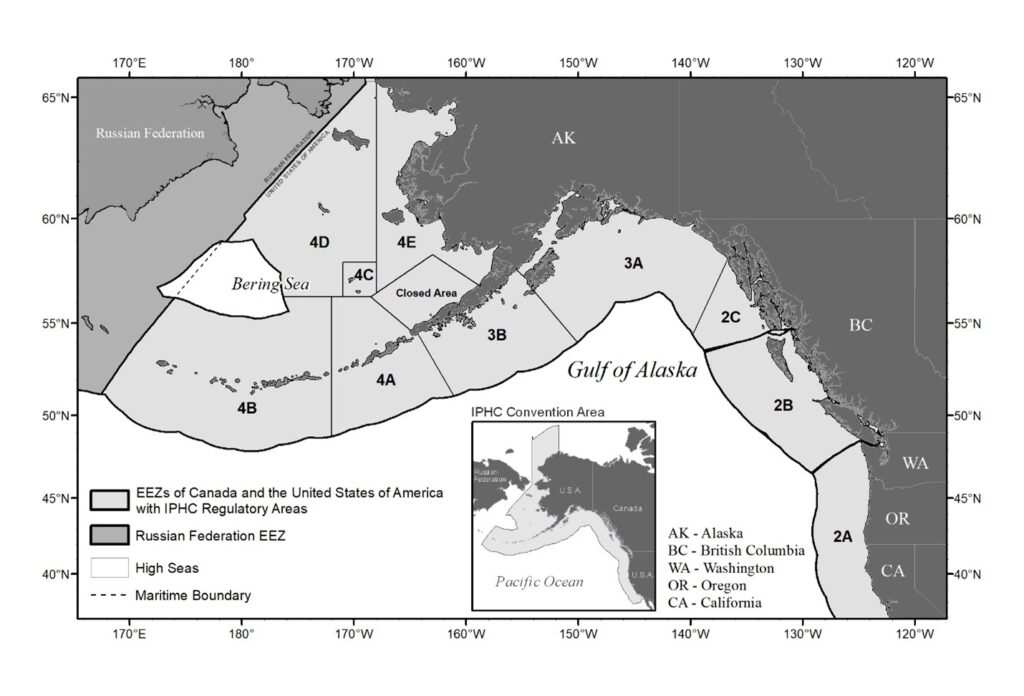
Research shows that Pacific halibut form a single genetic stock across their entire range and abundance estimates are, therefore, derived for the coastwide population. However, management of the resource is conducted on a Regulatory Area basis. IPHC first defined Regulatory Areas in 1932. Over the years, IPHC Regulatory Areas have been redefined and reshaped. The present arrangement was established in 1990. There are currently three major Regulatory Areas – Areas 2, 3, and 4, and each is further divided into subareas as shown in the map.